9.1 | Copyright, Licensing & AI Content
Key Terms
- Copyright
- Automatic legal protection, granted the moment an original work is fixed in a tangible form (saved, drawn, written), giving the creator exclusive rights to reproduce, distribute, and adapt their work.
- Intellectual Property
- Creations of the mind, designs, writing, logos, code, artwork, that the law treats as ownable property, protected through copyright, trademark, or patent depending on the type of work.
- Derivative Work
- A new work based on or adapted from an existing copyrighted work (a redrawn logo, a remixed illustration). Creating one generally requires the original copyright holder’s permission, even if the new version looks quite different from the source.
- Commercial Use
- Using a work to make money or promote a business, as opposed to personal or educational use. Many “free” assets are licensed for personal use only and require a separate, often paid, commercial license.
- Attribution
- Publicly crediting the original creator of a work, usually required as a condition of a specific license (for example, a Creative Commons BY license) even when the work is otherwise free to use.
- Work for Hire
- Work created by an employee within the scope of their job, or by a contractor under a signed work-for-hire agreement. The employer or client, not the person who actually made it, legally owns the copyright.
- Usage Rights
- The specific permissions a license grants for how a work may be used: where, for how long, in what medium, and for what purpose. Separate from who owns the copyright itself.
- Fair Use
- A U.S. legal doctrine allowing limited, unlicensed use of copyrighted material for purposes like commentary, criticism, education, or parody. It’s decided case-by-case, not by a fixed rule of thumb like “under 30 seconds is always fine,” using four factors: purpose of the use, nature of the original work, how much was used, and the effect on the original’s market.
- Fair Dealing
- The equivalent doctrine to fair use in the UK, Canada, and other Commonwealth countries. Narrower than U.S. fair use, since it only applies to a specific, enumerated list of purposes (research, criticism, news reporting) rather than an open four-factor test.
- Public Domain
- Works with no active copyright protection, either because it expired, the work was never eligible, or the creator deliberately released it (for example, marked CC0). Anyone can use a public-domain work for any purpose without permission or credit.
- Stock Images
- Professionally produced photos or illustrations licensed for reuse. “Royalty-free” means one payment covers many uses. It does not mean free of cost or free of restriction, so always check what the specific license actually permits.
- AI-Generated Content
- Images, text, or other media produced by a generative AI tool from a prompt. Copyright ownership of AI-generated content is legally unsettled and varies by platform terms of service and by jurisdiction. As of this writing, the U.S. Copyright Office holds that purely AI-generated output, without meaningful human creative authorship, cannot be copyrighted at all, which matters when a client expects to own a deliverable exclusively.
“I found it on Google Images” is not a license. Every asset you didn’t create yourself came with rules attached. Today’s job is learning to actually find and read them before you build a client’s project around them.
Last class you generated artwork with AI in a few seconds. Today answers the question that should raise: can you actually use it? Who owns it? And what about everything else you didn’t draw yourself. A stock photo, a font, a reference image? This lesson matters for every project you build for the rest of your career, not just this class.
[10 Mins] Bell Ringer / Hook
You find the perfect photo for a client’s flyer with a quick image search. Is it safe to use? What would you need to know first?
“‘I found it online’ tells us nothing about whether we’re allowed to use it. Today we learn what questions to actually ask.”
[10 Mins] Direct Instruction
“I Do”: the teacher walks through 4 scenario cards live, applying vocabulary from today’s lists to each one:
- A stock photo with a standard royalty-free license, used in a paid client project. Royalty-free means one payment covers repeated use. It does not mean free of cost or free of all restriction, so the specific license terms (not the word “royalty-free” alone) decide whether this commercial use is covered.
- A Creative Commons image marked “BY” (attribution required), used without crediting the photographer. The image may be free to use, but omitting required attribution violates the license even though no money changed hands.
- An AI-generated illustration a client wants to trademark as their exclusive logo. As of this writing, the U.S. Copyright Office holds that purely AI-generated content without meaningful human authorship can’t be copyrighted at all. A real problem if the client expects exclusive ownership, since anyone else could technically use the same output.
- A 3-second clip of a copyrighted song used as “fair use” background music in a monetized video. Fair use is decided case-by-case on four factors (purpose, nature of the work, amount used, market effect). There is no fixed “under 30 seconds” rule, and using it to make money weighs against fair use, not for it.
Check for Understanding Recall: “What’s the difference between a work being ‘free to use’ and being in the public domain?” Analysis: “Why doesn’t ‘royalty-free’ automatically mean an image is safe for a client’s paid project?” Synthesis: “A client asks you to build their whole brand identity using only AI-generated logos so they ‘don’t have to pay a photographer.’ What would you tell them about ownership before agreeing?”
[23 Mins] Guided Practice
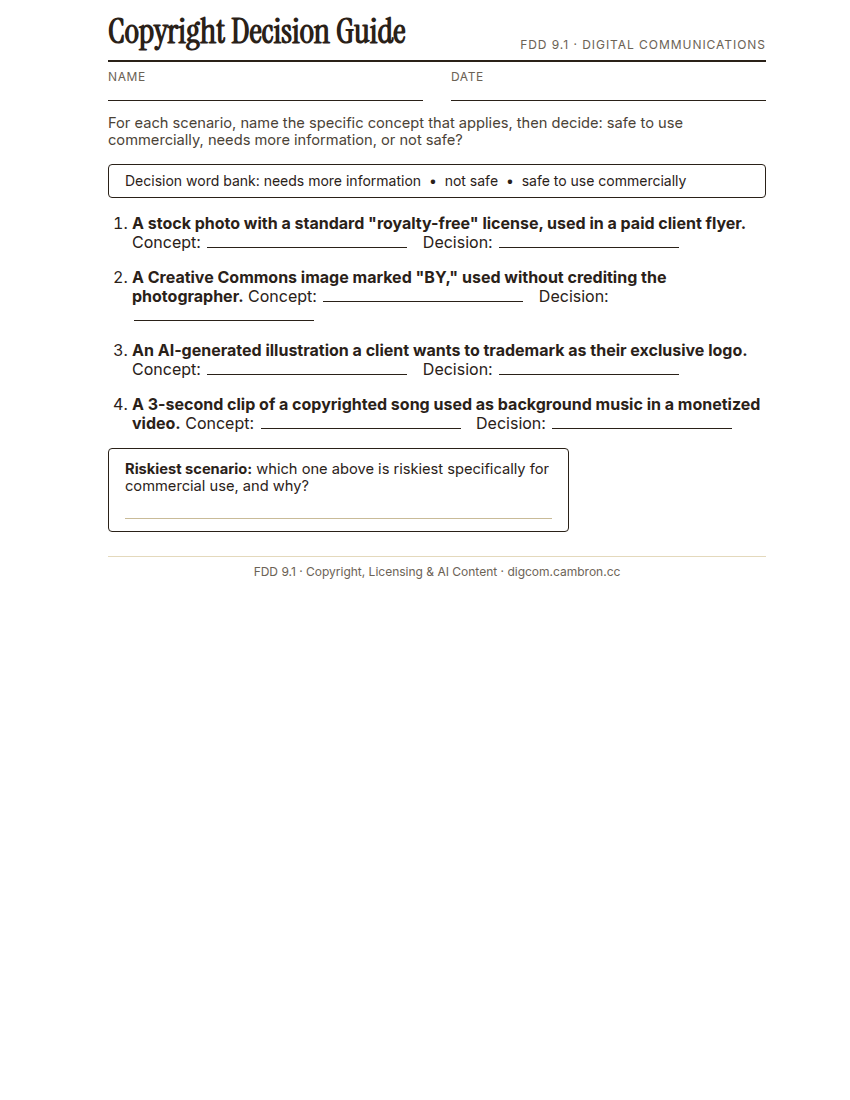
Complete the handout, three hole punch it, and keep it in your class binder.
⬇ Download Worksheet (PDF)Think-Pair-Share on each card before writing your own answer. Hear another perspective before committing to a justification.
- Work through at least 4 assigned scenario cards (a stock image, a Creative Commons asset, an AI-generated result, and a “fair use” claim).
- For each one, write a short justification naming the specific concept that applies. Don’t just guess “yes” or “no.”
- Identify the single riskiest scenario in your set and explain, in one sentence, what makes it risky specifically for commercial use.
[30 Mins] GMetrix / BrainBuffet Self-Guided Strand
Continue GMetrix. Once your class reaches Module 6. Generative AI & Exam Tips, its Creative Commons worksheet section is this lesson’s direct GMetrix match. Flag it for your teacher if you reach it before the rest of the class.
[5 Mins] Exit Ticket / Wrap-Up
🗂 Organize: Put your written justification for each scenario card (at least 4) and one sentence naming the single riskiest scenario and why in your binder.
📤 Exit Ticket: Stoplight. In the discussion board below, let us know how you’re doing: G (green: I’ve got this, ready to move on), Y (yellow: I mostly get it, still have a question), or R (red: I’m stuck, I need help). Then explain your rating in at least 3 sentences (aim for 5): what specifically about today’s skill makes you feel that way, and, if you’re yellow or red, what your actual question is.
Stuck on how to start? Try: “I picked ___ because ___. Specifically, when I tried to ___, I ___. One thing that would help is ___.”