12.2 | Rights & Clearances Documentation
Key Terms
- Call Sheet
- A daily production document listing what’s shooting, when, where, and who needs to be there. The single source of truth for everyone on set that day.
- Shooting Schedule
- The order scenes actually get filmed in, grouped by location and actor availability, almost never the same order as the finished story.
- Talent Release
- A signed document giving a production permission to record and use someone’s likeness. Required for every on-camera performer, even a friend doing a favor.
- Location Release
- A signed document giving a production permission to film at a specific place. Required for private property, sometimes required for public spaces depending on what’s being filmed.
- Line Item
- A single row in a budget, one specific expense (gear rental, location fee, catering) tracked separately so a producer can see exactly where money is going.
- Contingency
- Extra budget set aside for the unexpected (a reshoot, a broken prop, a rental that runs long). Industry standard is roughly 10 percent of the total budget.
You collected releases and made rights decisions back in 7.4. Today they become a real, cross-checked record, part of your Production Book, not scattered files nobody could find later.
Direct Instruction (~10 min)
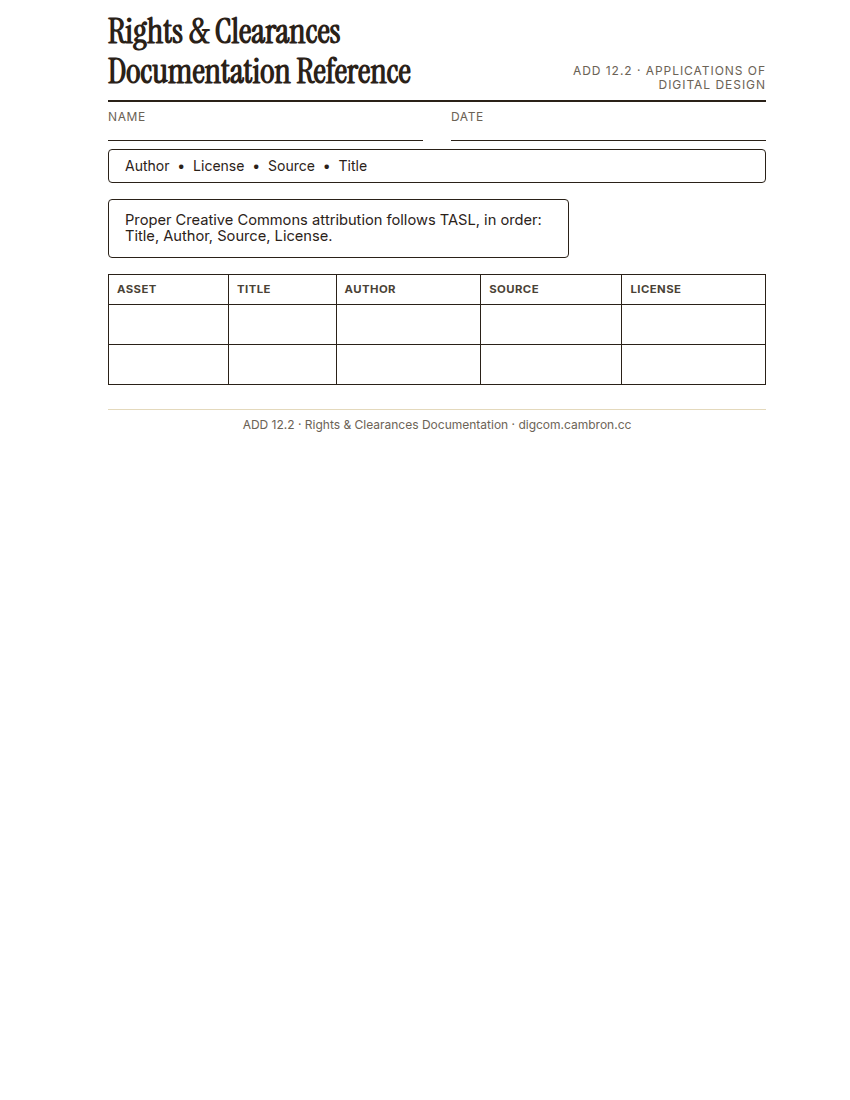
Complete the handout, three hole punch it, and keep it in your class binder.
⬇ Download Worksheet (PDF)Proper Creative Commons attribution follows a fixed order: Title, Author, Source, License (TASL). Missing any one of the four makes the attribution incomplete, even if the intent was right. A complete rights/clearances record isn’t just “we have releases somewhere,” it’s every release and every attribution, matched against the actual assets used in the finished film, filed together in one place.
“‘I’m pretty sure we cleared that’ is exactly the sentence a rights record exists to make unnecessary. If it’s not written down and matched to a specific asset, it’s not documented.”
Scaffolded questions. Cold-call through all three:
Recall: “What are the four parts of proper Creative Commons attribution, in order?”
Analysis: “Why does a rights record need to be matched against the FINAL film’s actual assets, not just the original shot list from 7.4?”
Synthesis/Extension: “Your group swapped one piece of music during editing. What does that change about your rights record?”
Guided Practice (~23 min)
- Gather every release and rights decision from 7.4.
- Format every Creative Commons attribution using Title-Author-Source-License.
- Build one compiled record listing every asset, its release/attribution, and its source.
- Partner check: cross-check a classmate’s attribution formatting for completeness.
Did your group find any asset in the final film that was missing a release or attribution? How did you resolve it?
Studio/Project Work Time (~30 min)
Cross-check your compiled record against the group’s actual final edited film, scene by scene, to confirm every used asset has a matching entry.
Exit Ticket / Wrap-Up (~5 min)
Save your file, then screenshot your completed record.
🗂 Organize: Put your guided notes in your binder. Save your rights and clearances record in the Documents folder of your Digital Design project folder on Google Drive.
📤 Exit Ticket: Glow & Grow. On a scrap of paper, write about today’s work in at least 3 sentences (aim for 5): describe one Glow (something that went well) and one Grow (one thing you’d do differently or improve next time), explaining each with real detail, not just a phrase.
Stuck on how to start? Try: “My Glow today was ___, because ___. My Grow is ___. Next time I’ll try ___.”