1.2 | Shape Assignment
Key Terms
- Color / Value
- Color is the perceived hue of an object; value is the lightness or darkness of a tone or color (white lightest, black darkest, middle gray halfway between). (Line, Shape, and Texture were covered on Line day, 1.1.)
- Mass/Form
- The way a three-dimensional form (or the illusion of one) appears to have weight, density, or bulk, based on how it’s created.
- Balance
- The distribution of one or more elements so they visually equal each other. Unequal distribution reads as asymmetrical.
- Alignment
- The lining up of text or graphics on a page.
- Contrast
- The range of light to dark areas in a composition. Greater contrast means a greater distinction between light and dark regions.
- Unity/Harmony
- Design elements working together both visually and conceptually, with no single element overpowering the whole.
- Proportion
- The harmonious relation of parts to each other or to the whole.
- Proximity
- Elements placed near each other read as related; elements spaced apart read as separate groups.
- Repetition
- Repeating a single element multiple times across a design.
- Rule of Thirds
- A layout principle suggesting a composition is most pleasing when key objects sit at the intersections of lines dividing the image into thirds. Used to draw emphasis to important elements.
- Rule of Phi / Golden Ratio
- A layout principle based on the mathematical ratio phi, historically used in art and architecture to create naturally pleasing proportions (related to the Fibonacci spiral).
Guided notes, then the second element assignment.
Part 1 | Guided Notes: Elements & Principles of Design (~12 min)
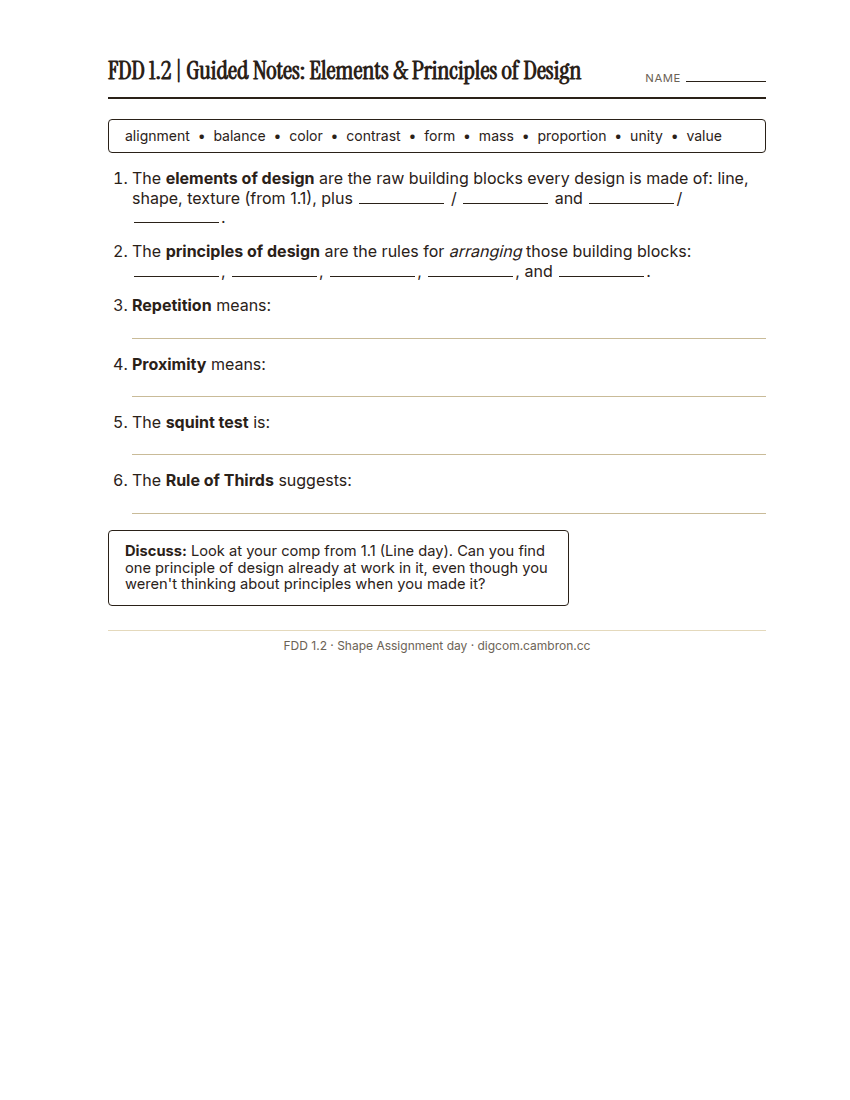
Complete the handout, three hole punch it, and keep it in your class binder.
⬇ Download Worksheet (PDF)“Elements placed close together read as one group. Elements spaced apart read as separate groups. Even if nothing on the page says so directly. That’s proximity, and it’s one of the fastest fixes for a messy layout.”
Squint test: close your eyes almost all the way and look at a layout blurred. Related items should visually clump together; unrelated items should visibly separate. If everything blurs into one undifferentiated blob, or if things that belong together read as scattered, proximity is the fix, not more decoration.
Look at your comp from 1.1 (Line day). Can you find one principle of design already at work in it, even though you weren’t thinking about principles when you made it?
Part 2 | Shape Assignment (~50 min)
Same process as Line day, thumbnail → rough → comp, this time using shape.
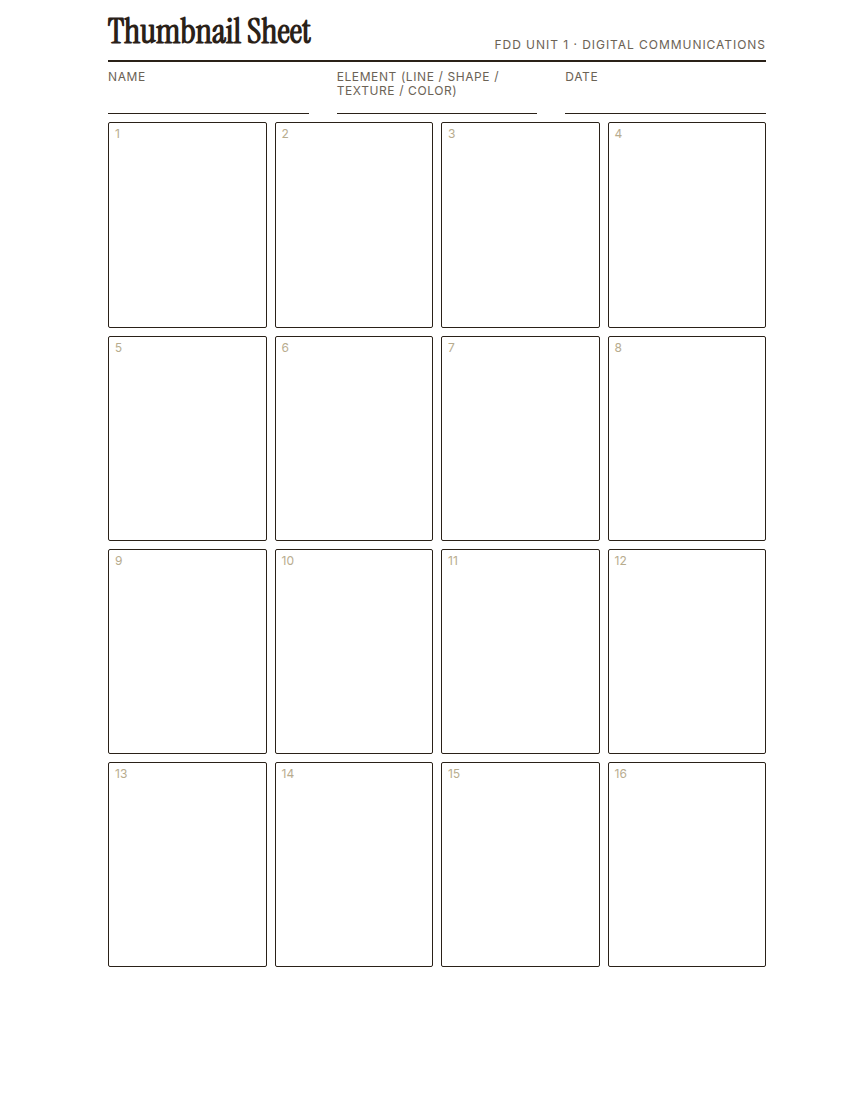
Complete the handout, three hole punch it, and keep it in your class binder.
⬇ Download Worksheet (PDF)- Thumbnails (~12 min): draw 16 thumbnails, each using 4 shapes with similar qualities (for example, all geometric, or all organic). Arrange the shapes in each box so the viewer’s eye can move easily from one to the next.
- Select (~2 min): choose your 3 strongest thumbnails.
- Roughs (~15 min): develop each into a rough sketch.
- Select (~1 min): choose your single strongest rough.
- Comp (~20 min): develop it into a finished comp. Pencil first, then black marker.
Wrap-Up (~6 min)
Photograph your finished comp. Keep it alongside your Line comp. You’ll pick your overall strongest from all four elements on the S | 1 project day.
Which felt more natural to generate ideas for. Line or shape? Why do you think that is?
🗂 Organize: Put your guided notes, your 16 thumbnails, your 3 roughs, and your finished comp in your binder.
📤 Exit Ticket: Glow & Grow. On a scrap of paper, write about today’s work in at least 3 sentences (aim for 5): describe one Glow (something that went well) and one Grow (one thing you’d do differently or improve next time), explaining each with real detail, not just a phrase.
Stuck on how to start? Try: “My Glow today was ___, because ___. My Grow is ___. Next time I’ll try ___.”