12.2 | Sketchbook Practice & Ideation
Key Terms
- Ideation
- The structured process of generating a large volume of ideas before evaluating or refining any single one. Quantity first, judgment later.
- Morgue File (Idea Library)
- A working designer’s personal, organized collection of clippings, printouts, screenshots, and references saved for future inspiration or reuse. A professional habit, not clutter.
- Divergent Thinking
- Generating as many different possible ideas or directions as you can, deliberately avoiding settling on the first workable one.
- Convergent Thinking
- Narrowing a large set of generated ideas down to the strongest one(s) by evaluating against a goal or criteria. The step that follows divergent thinking.
- Visual Research
- Deliberately gathering existing images, objects, and designs related to a project before generating original ideas, so new work is informed rather than working from a blank memory.
- Mood Board
- A collected arrangement of images, colors, textures, and type samples used to establish and communicate the intended look and feel of a project before production begins.
- Thumbnail
- A small, fast, rough sketch used during ideation to quickly try out many compositional ideas without investing time in any one of them.
Every designer needs a way to have a LOT of ideas fast, without getting stuck on the first one. Today’s lesson gives that process a name. And a workout.
Bell Ringer (~10 min)
Journal for a few minutes: when was the last time you had a genuinely good idea? Where were you, what were you doing, and what were you looking at right before it came to you?
Direct Instruction (~10 min)
Guided notes: ideation means generating a large volume of ideas before judging any of them. divergent thinking comes first (as many different directions as possible), then convergent thinking narrows the field down to the strongest one. A morgue file (idea library) is a working designer’s personal, organized collection of references saved for future inspiration. Look at a real example.
Why might generating 9 mediocre-looking ideas actually lead to a BETTER final result than carefully drawing just 1 idea from the start?
Guided Practice (~23 min)
As a class, we’ll try one round of rapid ideation together on a simple shared prompt. Then, with a partner, try a short mini-round on your own before independent work begins.
Studio/Project Work Time (~30 min)
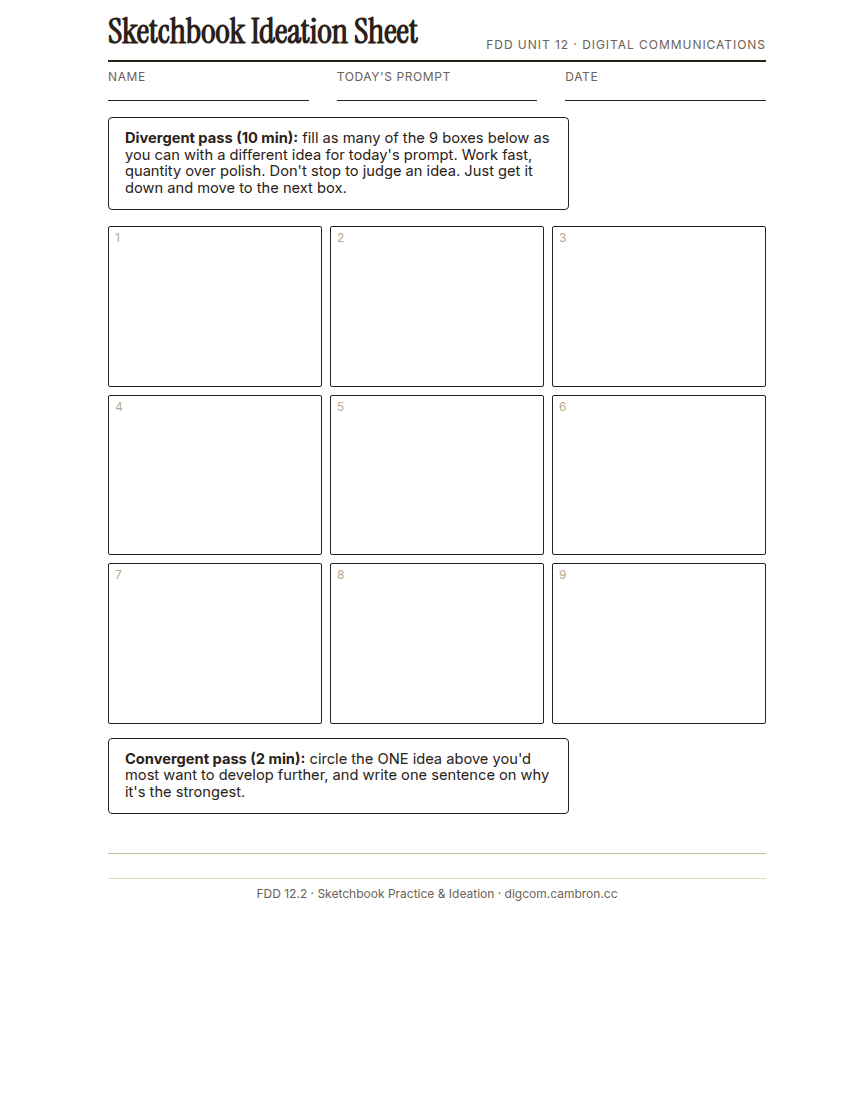
Complete the handout, three hole punch it, and keep it in your class binder.
⬇ Download Worksheet (PDF)Today’s constraint: listen for your teacher’s announced constraint at the start of this block. It has to show up in at least one of your 9 ideas.
- Divergent pass (~10 min): fill as many of the 9 boxes as you can with a different idea for today’s prompt. Work fast. Don’t stop to judge, just keep generating.
- Convergent pass (~2 min): circle the ONE idea you’d most want to develop further.
- Justify (~remaining time): write one sentence explaining why that idea is the strongest, then begin refining it further if time allows.
Which idea did you circle as your strongest, and what made it stand out from the other 8?
Exit Ticket / Wrap-Up (~5 min)
🗂 Organize: Put your completed ideation sheet (9 ideas, one circled and justified) in your binder.
📤 Exit Ticket: Glow & Grow. On a scrap of paper, write about today’s work in at least 3 sentences (aim for 5): describe one Glow (something that went well) and one Grow (one thing you’d do differently or improve next time), explaining each with real detail, not just a phrase.
Stuck on how to start? Try: “My Glow today was ___, because ___. My Grow is ___. Next time I’ll try ___.”