5.2 | Podcast Script
Key Terms
- Two-Way
- A radio term for a conversation between a host and a reporter or guest. The goal is to sound natural while still delivering accurate, prepared information.
- Bullet-Point Scripting
- Writing key facts, dates, and names as bullet points rather than full sentences, so the delivery stays natural instead of sounding read.
- Attribution
- Telling the listener out loud where information came from (“According to a study from…”). Required any time you share researched facts, not just opinion.
- The Arc
- The logical order of questions that makes an interview feel like a story, not a random list of questions.
- Hot Mic
- Treating every microphone as if it’s live the moment you sit down. Sounding natural starts before recording officially begins.
- Live-to-Tape
- Recording a full take start to finish without stopping, even though editing is possible afterward. Keeps energy and conversation authentic.
Writing for the ear is different than writing for the eye. Script every word and you’ll sound like a robot reading at your guest. Script nothing and you’ll ramble. Today’s the “Goldilocks Zone” in between.
Direct Instruction (~10 min)
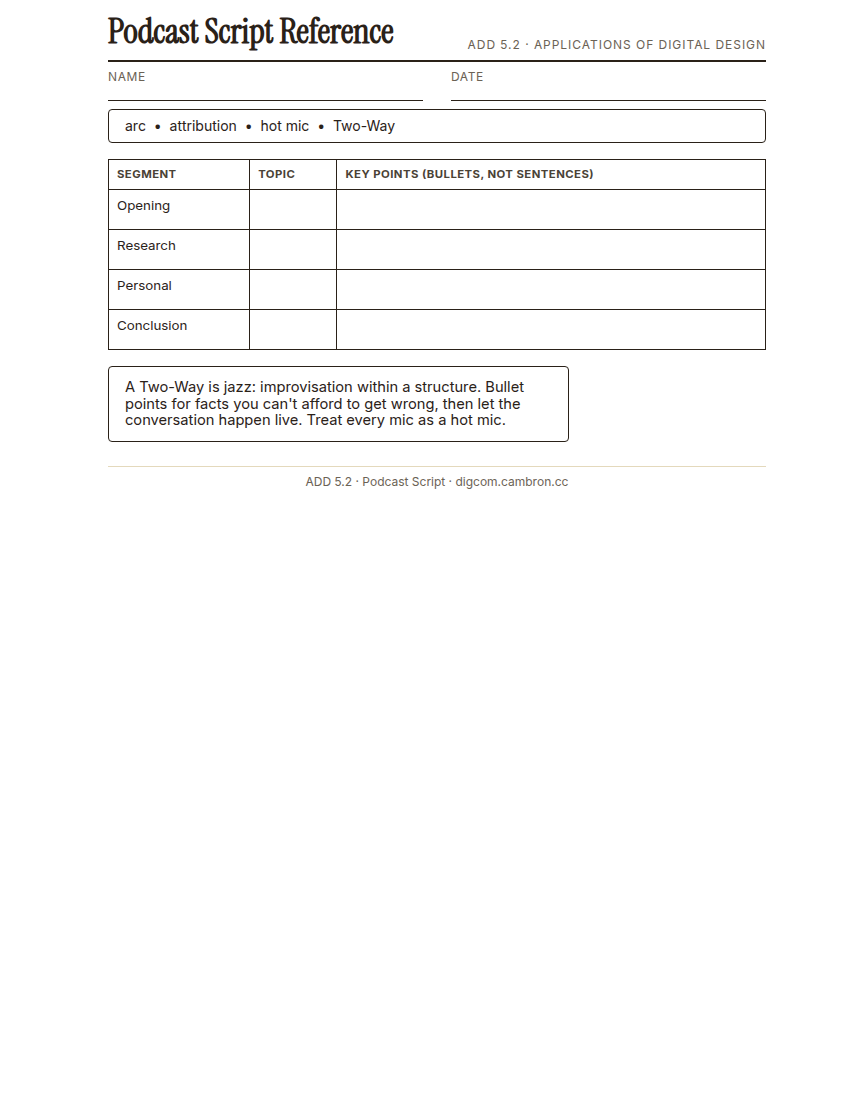
Complete the handout, three hole punch it, and keep it in your class binder.
⬇ Download Worksheet (PDF)“A Two-Way is jazz. Improvisation within a structure. Write bullet points for the facts you can’t afford to get wrong, then let the actual conversation happen live.”
Walk through: bullet-point scripting (facts as bullets, not full sentences), attribution (“According to a study from…”), building the arc (a logical question order), and treating every mic as a hot mic from the moment you sit down.
Scaffolded questions. Cold-call through all three:
Recall: “What’s the difference between scripting your questions and scripting the guest’s answers?”
Analysis: “Why does writing out a guest’s answers word-for-word usually make an interview sound worse, not better?”
Synthesis/Extension: “If a guest says something surprising that isn’t on your script, what should the host do?”
Guided Practice | Draft & Roadmap (~23 min)
- Draft your script using the sample structure: Opening / Research / Personal / Conclusion, with bullet-point key facts under each.
- Plan at least one out-loud attribution for a researched fact.
- Roadmap with a partner: without looking at your notes, tell them the 3 most interesting things you learned. If they look confused, simplify.
- Check attributions: did you actually mention your sources out loud during the Roadmap?
If your script has full sentences written out for what your guest will say, that’s the “Amateur Play” sound. Cut it back to bullet points and trust the conversation.
Cold call check: your partner’s Roadmap got tangled in technical jargon and you got confused. What’s the fix before recording day?
GMetrix/BrainBuffet (~30 min)
Continue Module 3: today’s sections extend into rolling credits and archiving workflows.
Exit Ticket / Wrap-Up (~5 min)
🗂 Organize: Save your bullet-point script in the Project Files folder of your Digital Design project folder on Google Drive.
📤 Exit Ticket: Glow & Grow. On a scrap of paper, write about today’s work in at least 3 sentences (aim for 5): describe one Glow (something that went well) and one Grow (one thing you’d do differently or improve next time), explaining each with real detail, not just a phrase.
Stuck on how to start? Try: “My Glow today was ___, because ___. My Grow is ___. Next time I’ll try ___.”