12.3 | Music Video: Mise-en-Scène & Planning
Key Terms
- Continuity Photo
- A reference photograph of a cast member’s costume or a location’s setup, taken before filming so hair, wardrobe, and set dressing can be matched exactly if a scene is reshot or filmed out of order across multiple days.
- Visual Reference
- Any image (a film still, a painting, a photo) collected to help a team agree on a shared look, mood, or tone before shooting begins, without needing every idea spelled out in words.
- Mise-en-Scene
- Everything visible within the frame that was deliberately arranged. settings, props, costume, lighting, color, and the positioning of people and objects. French for “placing on stage.”
- Slugline
- The all-caps shot heading that opens a scene (INT./EXT., location, time of day). Tells the crew where and when a scene happens before a single word of action or dialogue.
- Parenthetical
- A short direction in parentheses under a character’s name, telling an actor how to deliver a line (whispers), (sarcastic). Used sparingly, overusing them reads as micromanaging the actor.
- Scene Heading
- Another name for a slugline. INT. KITCHEN - NIGHT is a scene heading.
- Two-Column Script
- A script format that splits visuals (left column) from audio/dialogue (right column), common for commercials, music videos, and documentary-style projects instead of standard screenplay format.
- Beat
- A pause or turning point in a scene’s action or dialogue, marked in a script to control pacing and give an actor or editor a place to breathe.
A music video doesn’t have dialogue to script, it has a song. Today’s about pairing image to music with the same deliberateness you’d bring to any other script.
Direct Instruction (~10 min)
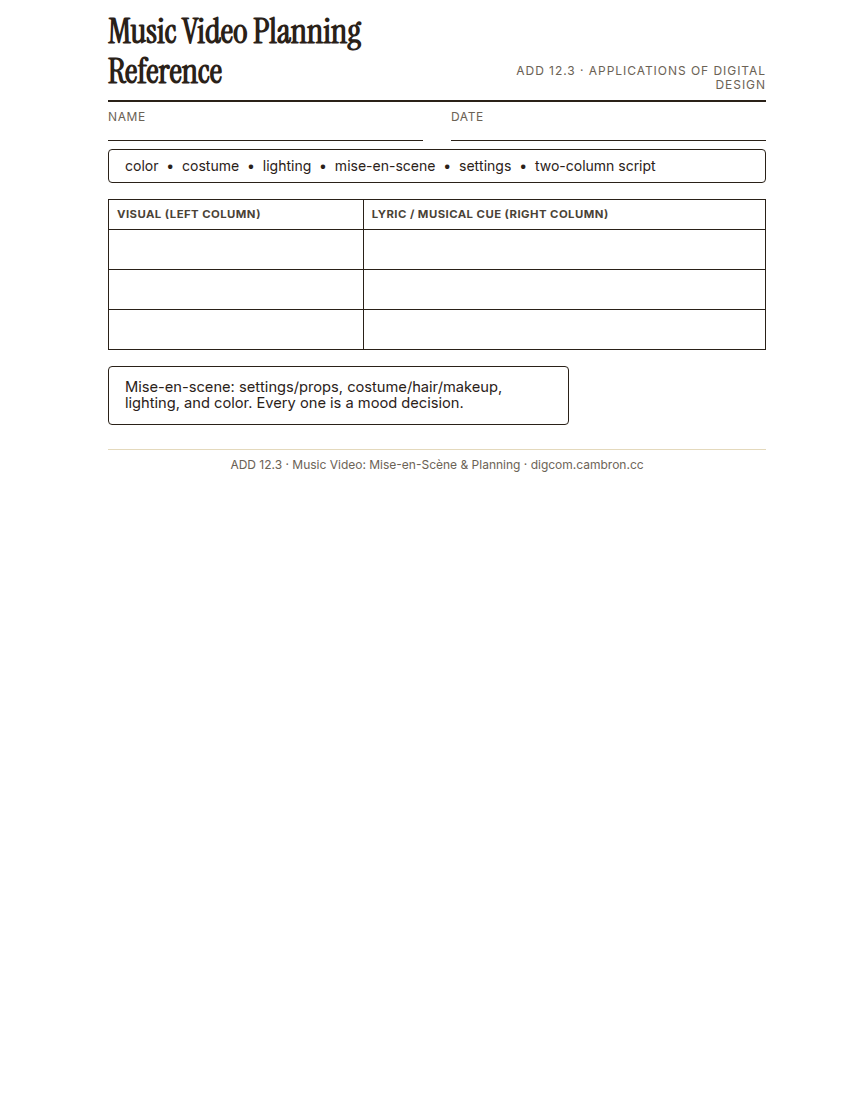
Complete the handout, three hole punch it, and keep it in your class binder.
⬇ Download Worksheet (PDF)A two-column script splits visuals (left) from lyrics/musical cues (right), so image and sound are planned together instead of one added as an afterthought. Mise-en-scène covers everything deliberately arranged in frame: settings and props, costume/hair/makeup, lighting (high-key, low-key, natural), and color. Every one of these is a mood decision, not just a production logistics decision.
“A verse and a chorus usually need to feel different, that’s often where mise-en-scène does the most work: a color shift, a lighting change, a costume detail that only shows up once the chorus hits.”
Scaffolded questions. Cold-call through all three:
Recall: “What’s on each side of a two-column script?”
Analysis: “Why might a music video use natural lighting for a verse and stylized, low-key lighting for the chorus?”
Synthesis/Extension: “Your chosen song shifts mood halfway through. What mise-en-scène element would you change to reflect that shift, and why that one specifically?”
Guided Practice (~23 min)
- Choose a song (royalty-free or public domain, per 7.4’s rights framework).
- Build a two-column script for the first verse and chorus, pairing visuals to lyrics/cues.
- Plan mise-en-scène for that section: settings, costume, lighting, color, with a reason for each choice.
- Small-group pitch: present your plan to another group and get feedback.
Which mise-en-scène element did the most work to set your song’s mood?
Studio/Project Work Time (~30 min)
Storyboard your planned section, then shoot a quick phone-camera test clip of one shot to check whether your mise-en-scène plan actually reads on camera.
Exit Ticket / Wrap-Up (~5 min)
Save your file, then screenshot your script and plan.
🗂 Organize: Put your guided notes in your binder. Save your two-column script and mise-en-scène plan in the Documents folder of your Digital Design project folder on Google Drive. Save your test clip in the Source Footage folder of your Digital Design project folder on Google Drive.
📤 Exit Ticket: Emoji Meter. On a scrap of paper, draw ONE face that matches how confident you feel about today’s skill: 🙁 (not yet), 😐 (getting there), or 🙂 (got it). Then explain why in at least 3 sentences (aim for 5), connecting your answer to something specific from today, not just a general feeling.
Stuck on how to start? Try: “I drew ___ because ___. Specifically, when I tried to ___, I ___. Next time I want to ___.”