7.2 | Purpose & Description
Key Terms
- Client Goals
- The outcomes a client wants a video to achieve: informing, persuading, entertaining, or building their brand. Those goals shape every creative decision on the project.
- Target Audience
- The specific group of viewers a video is made for. Understanding who they are shapes a video’s tone, pacing, and content choices.
- Demographics
- Measurable characteristics of a target audience, age, location, education, interests, used to describe and understand who a video is being made for.
Before you film a single shot, you need to be able to answer two questions in writing: why does this project exist, and what will it actually include?
Direct Instruction (~10 min)
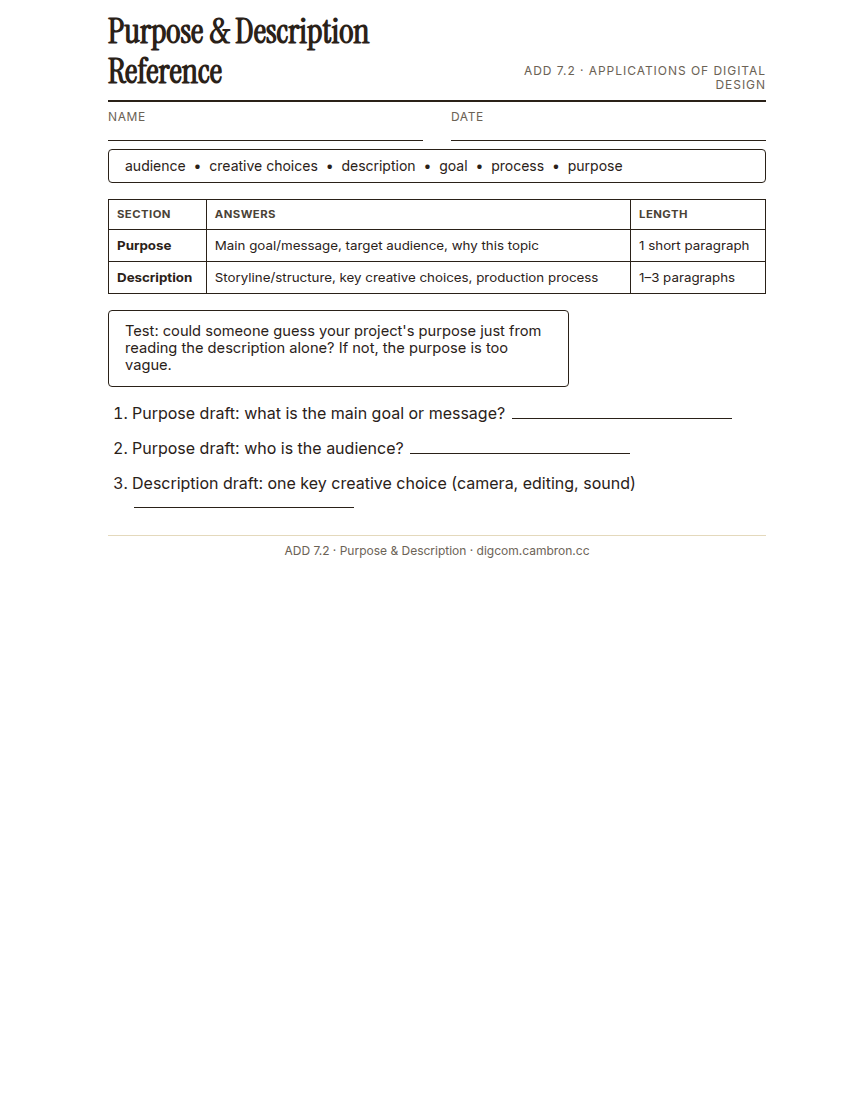
Complete the handout, three hole punch it, and keep it in your class binder.
⬇ Download Worksheet (PDF)A purpose statement answers why. the main goal or message, the audience you’re trying to reach, and why this topic or concept. A description answers what and how. a brief summary of the storyline or structure, the key creative choices (camera angles, editing techniques, sound), and the production process. Keep purpose to one short paragraph and description to one to three.
“If someone read only your purpose statement and never saw the video, could they guess what it’s actually about? If not, the purpose is too vague, too many projects say ‘to make people think’ without saying think about what, or for whom.”
Scaffolded questions. Cold-call through all three:
Recall: “What’s the difference between a purpose statement and a description?”
Analysis: “Why might a festival require both a purpose statement and a description instead of just a synopsis?”
Synthesis/Extension: “Your group’s short film changes direction halfway through production. What in your purpose statement would need to change, and what would stay the same?”
Guided Practice (~23 min)
- Draft your purpose statement as a group: main goal/message, target audience, why this topic. One short paragraph.
- Draft your description as a group: storyline/structure summary, key creative choices, production process. One to three paragraphs.
- Swap with another group. Can they tell you the purpose and audience just from reading your description, without reading your purpose statement separately?
- Revise based on that feedback.
Which was easier to write: the purpose (why) or the description (what/how)? Why do you think that is?
GMetrix/BrainBuffet (~30 min)
Continue this term’s Premiere Pro GMetrix module.
Exit Ticket / Wrap-Up (~5 min)
🗂 Organize: Put your guided notes in your binder. Save your group’s purpose/description draft in the Documents folder of your Digital Design project folder on Google Drive.
📤 Exit Ticket: Glow & Grow. On a scrap of paper, write about today’s work in at least 3 sentences (aim for 5): describe one Glow (something that went well) and one Grow (one thing you’d do differently or improve next time), explaining each with real detail, not just a phrase.
Stuck on how to start? Try: “My Glow today was ___, because ___. My Grow is ___. Next time I’ll try ___.”